Table Net Results
Summary Net Statistics in Lens tables help you see the overall performance of your filtered view at a glance. Let's discuss how we compute these statistics.
Written By Nathan Raymant
Last updated Over 1 year ago
Holistic Aggregation
Using the correct aggregation techniques is important for producing meaningful statistical overviews over large sets of data. Lens intelligently aggregates metric data so you always have meaningful net results.
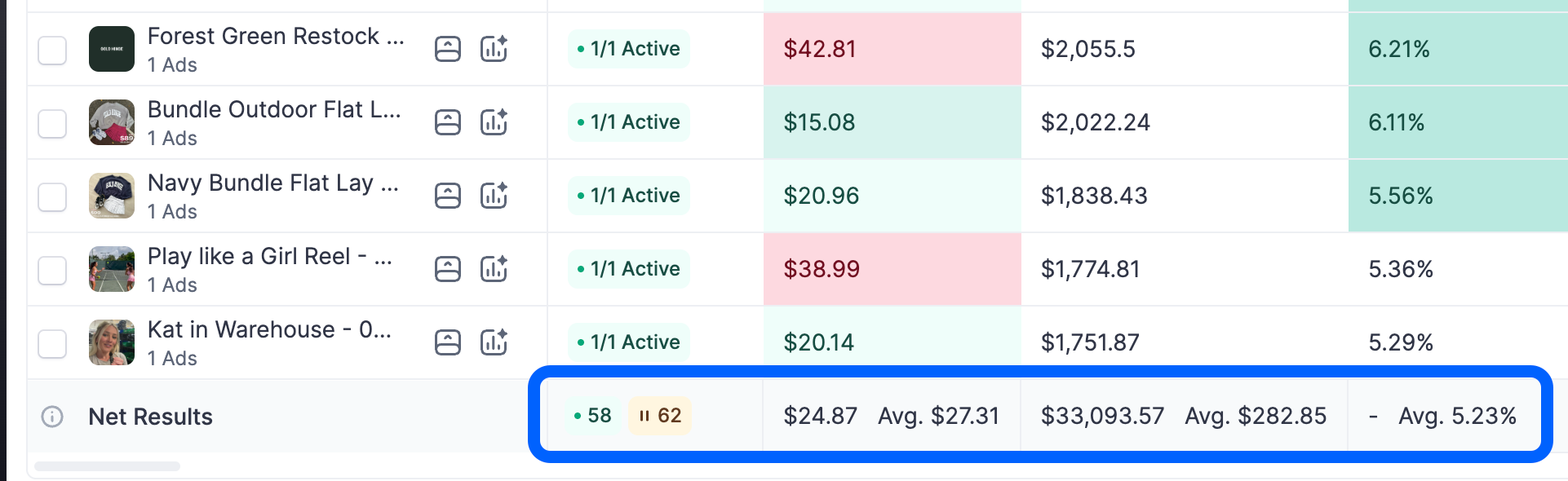
In the ‘Net Results’ row, which appears at the bottom of tables containing metric data, we display the net results for each column in the following format:<Net> Avg. <Weighted Average>
Computing Net Values
For net values (on the left), we display the aggregated value across all groups in the filtered view. Meaning if, for example, you were filtering your report to only include active ads, then we would only be aggregating across active ads.
For base metrics (i.e., simple counts that we get directly from Meta, such as spend, impressions, etc.) we sum the values of all the rows in the table.
For computed metrics (i.e., any metric that depends on a formula, such as rates, ratios, percentages, etc.), we apply the formula again on the highest level, using the summed base metrics.
For example, when computing Net CPM (Cost per Mille), we take the sum totals for spend and impressions, and use those values to compute the overall Net CPM:
Net CPM = (Total Spend / Total Impressions) * 1000
Computing Weighted Averages
For averages (on the right), we compute the values using a system of weights depending on spend. This means that ads/groups with a higher proportion of the total spend will contribute more to the average value compared to ads/groups with relatively less spend.
This strategy ensures average values are more reflective of performance over greater user exposure.
Why is this useful?
Say you have an ad that has $20 spend, and that ad makes a conversion for a value of $200 (lucky!) — This would result in the ROAS for this ad being computed at 10. Of course this is an anomalously high ROAS, and is not generally reflective of how the ad would perform at scale.
Weighting by spend helps to reduce the impact of low-spend outliers, resulting in a more accurate overview of how these ads are performing under typical conditions.
Was this helpful?
Still need help? Share an idea